- 13th Mar, 2026
- Jaundice Doctor
Genetic Conditions That Can Cause Jaundice
Noticing a yellowish tinge in your skin and eyes is an alarming sign that something is not right in your body. This is the symptom of jaundice, which happens when an individual suffers from an underlying condition primarily related to the liver, bile duct obstruction and excessive breakdown of red blood cells.
However, at times, the disease is linked to genetic conditions that affect the body’s ability to process bilirubin, a pigment responsible for causing yellow discolouration in the body.
Understanding the genetic causes is essential for knowing when to monitor symptoms and seek specialised care from an experienced doctor for jaundice, such as Dr. Indraneel Saha.
What Is Jaundice?
Jaundice, or hyperbilirubinemia, is a condition that is caused by excessive accumulation of bilirubin in the bloodstream. Bilirubin is a yellow pigment produced when red blood cells (RBCs) break down. Normally, bilirubin is processed in the liver, converted into a form that can be excreted, and eliminated from the body through bile and stool.
Normally, the bilirubin is processed through the liver and is excreted from the body. However, if there is excessive bilirubin production, impaired processing, or blockage in the bile flow, the bilirubin accumulates in the blood, leading to yellow discolouration.
Sometimes, genetic mutations also impair the pathway leading to recurrent jaundice.
Let’s discuss some of the inherited conditions that are responsible for bilirubin buildup and jaundice.
Key Genetic Causes Of Jaundice
Dr. Indraneel Saha, a leading doctor for jaundice, lists the following genetic conditions that can impair the production of jaundice.
- Gilbert syndrome: This is one of the most common causes of mild jaundice. Here, the mutations in the UGT1A1 gene reduce the liver’s ability to conjugate bilirubin. The symptoms are often mild and are often triggered by stress, fasting and dehydration. In the majority of cases, the condition is benign, but doctors usually carry out tests to rule out serious disorders.
- Crigler–Najjar syndrome: It is a rare, recessive and autosomal genetic disorder causing severe, chronic unconjugated hyperbilirubinemia due to a deficiency or absence of the liver enzyme UGT1A1, which is responsible for processing the bilirubin. There are two main types.
- Type 1: Complete absence of the UGT1A1 enzyme, which is extremely severe. Requires more intensive treatment; otherwise, it can lead to kernicterus or brain damage.
- Type 2: Here, the enzyme activity is partial. Often milder but still need constant monitoring.
- Dubin–Johnson syndrome: It is also a recessive genetic disorder that causes chronic and intermittent jaundice. It is caused by mutations in the ABCC2 gene, which impairs the transport of bilirubin from hepatocytes into bile, resulting in a characteristic dark-pigmented or black liver. It is usually benign, but a doctor for jaundice recommends routine testing to prevent complications.
- Rotor Syndrome: Similar to Dubin-Johnson syndrome, it is caused by mutations in the SLCO1B1 and SLCO1B3 genes without liver pigmentation. It leads to chronic, non-hemolytic jaundice due to elevated conjugated bilirubin in the blood. Management requires monitoring at regular interventions.
- Hereditary spherocytosis: It is also a hereditary blood disorder where red blood cells become rigid, sphere-shaped, and prone to premature destruction in the spleen (haemolytic anaemia). Symptoms include jaundice, anaemia, dark urine and shortness of breath.
When To See A Doctor For Jaundice?
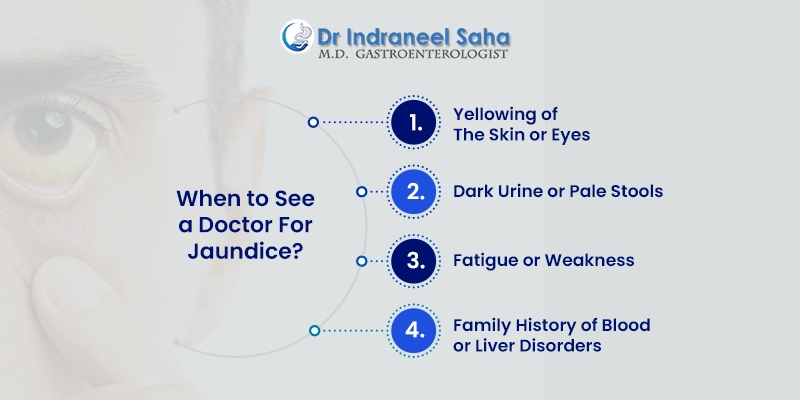
If you or someone you know experiences the following symptoms, it is advisable to consult a doctor for jaundice, who will recommend tests to measure bilirubin levels and to find out if the cause is genetic or acquired.
- Yellowing of the skin or eyes
- Dark urine or pale stools
- Fatigue or weakness
- Family history of blood or liver disorders
Conclusion
All the above conditions highlight the complex relationships between our genes and bilirubin metabolism. While in the initial stages, some conditions are harmless, if left untreated, can even turn life-threatening. Make sure to visit your doctor to identify the inherited causes and seek a timely diagnosis.