- 26th Mar, 2026
- Capsule Endoscopy
Things You Didn’t Know About Capsule Endoscopy
Capsule endoscopy, as a non-invasive procedure to diagnose the gastrointestinal tract, has become invaluable, allowing doctors to view the areas of the digestive tract that were once difficult.
Often known as the pill cam test, the method provides images related to the small intestine, stomach and other areas of the GI tract to detect abnormalities that at times go undetected.
It is an examination where patients are required to swallow a tiny pill-sized capsule that spans thousands of images along the way. The procedure offers several advantages, such as no sedation, no hospitals and almost negligible complications.
But beyond the basic concept, there are several facts associated with capsule endoscopy which many patients are not even aware of.
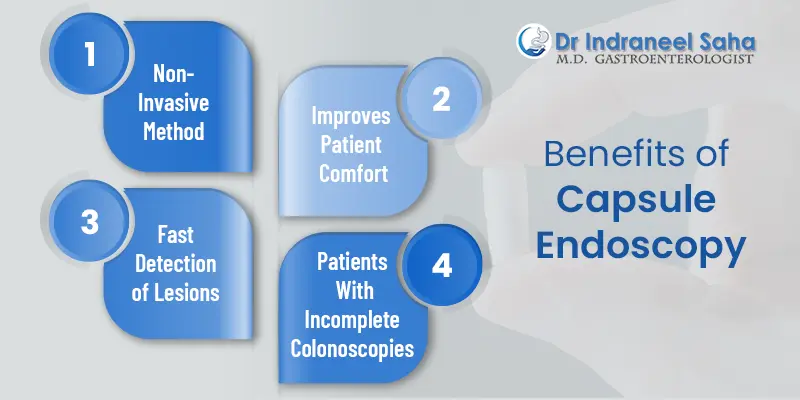
Benefits Of Capsule Endoscopy
- Non-invasive method: Eliminates the need for anaesthesia
- Improves patient comfort: Well-tolerated by patients
- Fast detection of lesions: Helps in the early detection of lesions and gastrointestinal bleeding.
- Appropriate in patients with incomplete colonoscopies: Beneficial for patients with incomplete colonoscopies or suspected small bowel pathology.
Surprising Facts Related To Capsule Endoscopy
Take a look at some of the lesser-known facts that most people don’t know about capsule endoscopy.
- The capsule is smaller than you think
Most individuals have the notion that the capsule might be too large and uncomfortable to swallow. However, in reality, it is like a disposable vitamin pill, which is roughly 26 mm long and 11 mm wide. Moreover, it is equipped with a miniature video camera, LED light sources, silver-oxide batteries and a radio telemetry transmitter.
- It was inspired by missile technology
Capsule endoscopy was not originally designed for medical purposes, as individuals believe it to be. The wireless transmission technologies used in early capsules were basically adapted from military imaging systems. Later on, engineers realised that miniature cameras and transmitters could be used for imaging the human body. This made it possible to view parts of the gastrointestinal tract.
- The capsule can take 50,000 images
The capsule captures two images per second and records more than 50,000 images during the 8-hour examination. That’s more than a traditional endoscopy examination. The pictures are then transmitted to the recorder worn around the patient’s waist, which takes around 30 to 90 minutes to review by a gastroenterologist like Dr. Indraneel Saha.
- It detects what traditional endoscopic procedures fail to do
Standard upper endoscopy or colonoscopy cannot fully visualise the small intestine, which is a long organ about 6 to 7 metres long. It can only provide access to the ends of the small intestine and leaves the middle section unexamined. In such situations, detecting conditions such as obscure gastrointestinal bleeding, tumours, Crohn’s disease and Celiac disease complications becomes an issue that requires invasive treatments.
- The procedure does not require sedation
One of the biggest advantages of capsule endoscopy is that the procedure does not require anaesthesia or sedation. Moreover, there is no recovery time, and patients can resume their daily activities soon after the procedure. Unlike traditional endoscopy, individuals also do not experience any kind of throat discomfort.
- There is no major risk of complications
Capsule endoscopy does not lead to any kind of complications when performed by an experienced gastroenterologist like Dr. Indraneel Saha. Though rare, the only complication is that the capsule might get stuck, which is known as capsule retention. In the majority of cases, it happens in individuals with narrowed intestines or bowel obstructions. Dr. Indraneel Saha usually recommends imaging tests to rule out such risks.
- The capsule gets excreted through the body
The capsule gets excreted through the body’s bowel movements within 24 hours. It cannot be reused. Most patients do not even notice when it passes. Even if they do, there is no need to return it to the clinic.
- Capsule endoscopy is not for the small intestine anymore
Primarily designed to visualise the small intestine, the technology behind capsule endoscopy has now expanded. Specialised capsules are now available for the esophagus, colon and other inflammatory conditions. The procedure has become a great alternative for patients who cannot undergo capsule endoscopy.
- The procedure can monitor treatment progress
Capsule endoscopy has been used as a diagnostic tool; however, it is now playing a significant role in gastrointestinal disease management. For example, patients with Crohn’s disease can undergo capsule endoscopy to monitor healing and assess small bowel mucosal healing, detecting deep or superficial mucosal lesions and identifying post-surgical recurrence.
- Capsule endoscopy helps with surgical intervention
For individuals with obscure bleeding, capsule endoscopy can help the surgeon with surgical decisions, like whether the patient needs a minimally invasive procedure or an open method. For example, it can detect the exact lesion location, which aids surgeons in carrying out the operation accurately. This in turn reduces surgical time, recovery period and even complications.
Future Of Capsule Endoscopy
According to Dr. Indraneel Saha, the future of capsule endoscopy will evolve due to technological advancements. Researchers are now developing smarter capsules that would enhance the imaging techniques and even deliver medication to the targeted areas in the gastrointestinal tract. This will significantly revolutionise the way doctors diagnose digestive disorders, especially those related to the small intestine.
Moreover, integration of artificial intelligence can also significantly reduce the time spent by gastroenterologists to review the images and improve diagnostic accuracy. As a result, the procedure will become more effective in diagnosing various conditions, offering hope for timely diagnosis.
Capsule endoscopy will definitely redefine gastrointestinal care, providing safer, faster and minimally invasive care into how GI diseases are detected and treated.
Conclusion
Capsule endoscopy provides detailed insights into conditions that were once difficult to identify. If you are someone who needs to undergo capsule endoscopy, book an appointment with Dr. Indraneel Saha. He is a leading gastroenterologist with advanced training in the procedure to guide you throughout the process, address your concerns and ensure comfort.