- 18th May, 2026
- ERCP Stone Extraction
What Happens During an ERCP Stone Extraction?
Are you suffering from jaundice, fever and abdominal pain? Well, this might point to stones in the bile ducts, which interfere with the flow of bile. When left untreated, these stones cause life-threatening infections like cholangitis.
This is when an expert gastroenterologist like Dr. Indraneel Saha suggests ERCP stone extraction as a minimally invasive solution to remove the stones effectively.
The procedure combines an endoscope and X-rays to precisely locate and remove the stones without the need for any invasive surgeries.
In this blog, we will discuss how the procedure works in a step-by-step guide.
What is ERCP?
Endoscopic Retrograde Cholangiopancreatography, or ERCP, is a specialised procedure which is used to diagnose and treat stones in the bile ducts, pancreatic ducts, and gallbladder. When stones, strictures, tumours or other blockages occur, they cause symptoms like abdominal pain, fever and even pancreatitis. In some cases, the blockages can even trigger pancreatitis or cholangitis, conditions that are potentially life-threatening if untreated.
Imaging tests such as ultrasound, CT scans, or MRCP detect these stones. Once identified, one of the uses of ERCP is stone extraction. ERCP stone extraction is a minimally invasive procedure that safely removes the stones with specialised tools like brackets and balloons.
It is standard treatment because it allows direct access to the bile ducts without any open surgical intervention.
How does the procedure work?
Here is the step-by-step guide on how the procedure works.
Patient preparation
Before the procedure, all patients are asked to strictly adhere to post-operative instructions provided by the surgeon for successful outcomes. For example, you might be asked to fast for at least a few hours to reduce the risk of aspiration and repeated tests. Also, don’t forget to inform your doctor about the medicines you are taking. If required, patients are generally asked to stop taking them or make necessary adjustments.
Sedation and positioning
Dr. Indraneel Saha usually uses anaesthesia to sedate the patients to ensure that they feel comfortable during the procedure. The endoscope is then carefully inserted through the mouth and advances to the duodenum. At the junction where the bile duct meets the intestine, there is a small opening called the ampulla of Vater. Using a technique called cannulation, the doctor gently introduces a thin catheter into the bile duct.
Stone extraction
To view the exact location of the stones clearly, a gastroenterologist uses a contrast dye during the ERCP stone extraction, which is injected, and X-ray imaging is used in real-time. This step allows the doctor to see the size, number, and location of the stones, ensuring a targeted approach for removal.
- Basket extraction: A tiny wire basket is inserted through the endoscope and opened inside the bile duct. The stones are captured in the basket, which is then carefully pulled back.
- Balloon extraction: It involves using a balloon catheter, which can also be used, inflated just past the stone and then pulled toward the intestine, sweeping the stones along with it.
Recovery process
After the stones are removed, patients are under supervision to monitor them until the sedation wears off. Most individuals can return to their normal diet and resume their daily activities within a few days, depending on the severity of the condition and the overall health of the patients. However, make sure to follow the post-operative instructions to ensure proper healing.
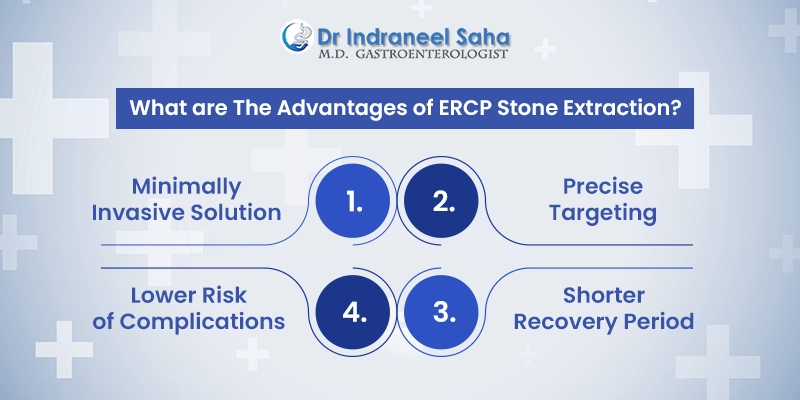
What are the advantages of ERCP stone extraction?
ERCP stone extraction offers significant advantages over traditional endoscopy.
- Minimally invasive solution
- Precise targeting
- Shorter recovery period
- Outpatient procedure
- Lower risk of complications
- Safe for high-risk patients
- Repeatable if necessary
Conclusion
ERCP stone extraction is the standard treatment for bile duct stone removal. For anyone experiencing symptoms like jaundice, abdominal pain, or fever due to bile duct stones, get in touch with Dr. Indraneel Saha to undergo ERCP, which offers a highly effective and patient-friendly solution.