- 29th Oct, 2026
- Jaundice Doctor
Pre-Hepatic, Hepatic, and Post-Hepatic Jaundice: What’s the Difference?
Your skin and eyes turn yellow, and your urine colour becomes brownish. These are often the first signs that something is not right in your body and that the bilirubin levels have increased.
The condition is known as jaundice and mostly happens when the liver cannot process bilirubin, and the bile cannot flow out of the liver properly.
Jaundice is a symptom that your liver, gallbladder and bile ducts are not working and needs to be treated. This is why two people with similar severity of jaundice require individual assessment and a different treatment approach.
A jaundice treatment doctor generally classifies the condition as pre-hepatic, hepatic, or post-hepatic based on where in the body the problem has started.
How Does Bilirubin Work?
To begin with understanding the types of jaundice, let’s know what bilirubin usually does under normal circumstances.
The average lifespan of red blood cells in the body is about 120 days, after which they start losing enzyme activity and become denser. When they die, the haemoglobin is converted to unconjugated (indirect) bilirubin. It is not water-soluble, so it gets attached to the protein called albumin to reach the liver through the blood.
The liver processes the indirect bilirubin with an enzyme (UGT1A1) to turn it into a water-soluble form called conjugated (direct) bilirubin.
It then enters bile, which eventually flows into the intestine through the bile ducts and finally leaves the body in stool and a small amount in urine.
Whenever there is a disruption in any of the following steps, the bilirubin starts accumulating in the bloodstream, thereby giving rise to jaundice.
What are the Types of Jaundice?
A jaundice treatment doctor categorises the condition into three forms depending on whether the underlying cause is due to breaking down blood cells, filtering bilirubin or excreting the waste from the blood.
- Pre-Hepatic Jaundice: It occurs before bilirubin reaches the liver for processing. The main cause is excessive accumulation of red blood cells, a process known as haemolysis. When too many red blood cells break down rapidly, the liver cannot process them efficiently. An individual with pre-hepatic jaundice often has an enlarged spleen with signs of anaemia but normal urine and stool. Treatment usually focuses on addressing the triggers, such as autoimmune haemolysis, treating malaria, stopping an offending drug, or asking to refuse blood transfusions when needed.
- Hepatic Jaundice: Here, the problem lies with the liver. When liver cells become damaged, or their function is impaired, bilirubin may accumulate. Treatment is based on the underlying cause. For instance, for viral hepatitis, patients might need antiviral medicines or vaccinations; alcoholic cirrhosis requires complete abstinence, and severe liver disease may require a transplant. Symptoms usually vary among patients, but they mostly experience raised liver enzymes, fatigue, nausea, loss of appetite, abdominal discomfort and frequent bruising.
- Post-Hepatic Jaundice: It occurs when the liver processes bilirubin normally, but bile cannot drain into the intestine because of a blockage in the bile ducts. This condition is also called obstructive or cholestatic jaundice. Common causes include gallstones, tumours of the pancreas or bile duct, bile duct strictures, pancreatitis, and biliary atresia in infants, for which a personalised treatment plan is prepared. Typical symptoms include pale, clay-coloured stools, very dark urine, intense itching, upper abdominal pain, and sometimes fever and chills in case of infections.
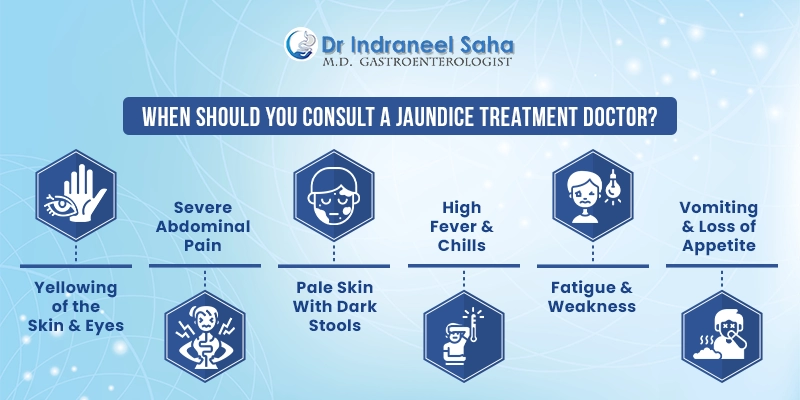
When Should You Consult a Jaundice Treatment Doctor?
Don’t wait for jaundice to settle on its own; book an appointment with a jaundice treatment doctor like Dr. Indraneel Saha if you notice the following.
- Yellowing of the Skin and Eyes for More Than Two or Three Days.
- Severe Abdominal Pain
- Pale Skin With Dark Stools
- High Fever and Chills
- Fatigue and Weakness
- Vomiting and Loss of Appetite
Conclusion
Pre-hepatic, hepatic and post-hepatic jaundice share similar symptoms, but the underlying cause is different. Identifying the problem is equally important as diagnosing the symptoms. Consulting a qualified jaundice treatment doctor helps in detecting liver, blood or biliary conditions.