- 13th Nov, 2025
- Capsule Endoscopy
Is Capsule Endoscopy Safe & Effective for Elderly Patients?
Whenever patients experience severe abdominal pain, gastrointestinal bleeding or constant anaemia, a gastroenterologist usually suggests capsule endoscopy. It is one of the breakthrough revolutions in the field of medicine that helped doctors to visualise abnormalities in the small intestine.
The method has emerged as a safer alternative to the traditional endoscopic procedure that fails to reach the entire small intestine due to the curves and loops of the organ.
However, the thought of swallowing a capsule with a tiny camera inside sounds worrisome, especially among the older population. The elderly patients and their families wonder whether the procedure is at all safe and effective.
In this blog, let’s explore how capsule endoscopy works, its benefits and what makes it a reliable examination, particularly for the aged patients.
What Happens During Capsule Endoscopy?
Capsule endoscopy is a modern diagnostic procedure that allows the doctor to examine the lining of the gastrointestinal (GI) tract, especially the small intestine. It is recommended to detect abnormalities like tumours, obscure gastrointestinal bleeding, ulcers, Crohn’s disease, celiac disease, or unexplained anaemia.
During the test, patients are asked to swallow a tiny capsule that is almost the size of a vitamin pill. Inside the capsule is a small wireless camera that is responsible for taking images as it travels through the digestive system.
The pictures are then transmitted to a recorder that a patient wears around the waist. The capsule is naturally eliminated from the body through stool, usually within 24 hours.
Common Concerns Of The Ageing Patients
Despite the several benefits of capsule endoscopy, the procedure might seem intimidating for older patients. This is primarily because they often have multiple comorbidities and a higher likelihood of side effects.
Dr. Indraneel Saha, a reputed gastroenterologist, addresses some of their doubts.
- What If The Capsule Gets Stuck?
Capsule retention is extremely rare, with only a few cases reported since the technology’s introduction. Before the examination, most doctors assess the overall health of the patients to look for strictures, tumours, or inflammation that might cause the blockage. In some cases, even a patent capsule is used to ensure safe passage.
- Is It Difficult To Swallow?
As mentioned, the capsule is about the size of a small vitamin pill, which makes it easier to swallow with water. For the aged patients with pre-existing swallowing disorders or anatomical abnormalities, the doctor might consider endoscopic placement of the capsule in the intestine.
- Can It Interfere With Pacemakers?
Application of modern capsule endoscopy is safe in patients with pacemakers and other medical devices like cardioverter defibrillators and left heart assist devices. However, it is always advisable to discuss with your doctor as a precautionary step.
- What About The Image Quality?
In very rare cases, certain factors such as incomplete pre-procedure preparation or minor bowel obstruction may result in reduced image quality. However, this usually does not hinder the diagnostic accuracy, especially when performed by experienced gastroenterologists. They carefully review the images to ensure that no important findings are overlooked.
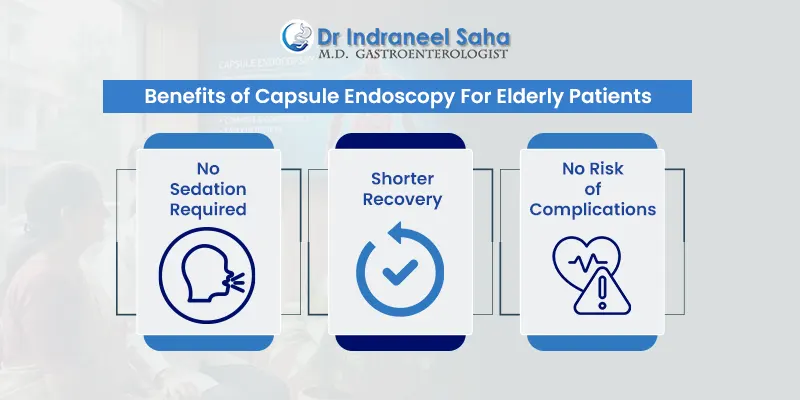
Benefits Of Capsule Endoscopy For Elderly Patients
Capsule endoscopy offers several advantages for both elderly and young patients. Dr. Indraneel Saha, a leading gastroenterologist, lists some of them.
- No sedation required: It is non-invasive in nature, making it comfortable for patients with high blood pressure and rapid changes in heart rate.
- Shorter recovery: Patients can return to their normal activities immediately after the procedure.
- No risk of complications: Post-procedure complications are rare, especially when patients are carefully screened beforehand for pre-existing conditions.
Conclusion
Capsule endoscopy represents one of the remarkable innovations with high diagnostic yield. It proves to be an invaluable tool in allowing for accurate diagnoses without any discomfort for an improved quality of life.