- 27th Jan, 2026
- Esophageal Dilatation
Esophageal Dilatation vs Surgery: Which is Right for You?
Do you often feel that the food you are consuming is getting stuck in your chest or halfway down? Well, swallowing difficulty due to esophageal strictures is a condition that affects many individuals. If left untreated for a long time, it results in malnutrition, decreased quality of life, and overall health.
When it comes to getting treatment, medicines are prescribed only to provide temporary relief. For a permanent solution, two of the effective approaches include esophageal dilatation and surgery.
But which procedure do you need? In fact, there is no universal answer to this question. The technique that you need actually depends upon the cause and severity of the disorder.
This blog will list the differences between esophageal dilatation and surgical intervention to help you understand which option might be right for you.
What Causes Difficulty In Swallowing?
The esophagus is a tube that connects the throat to the stomach, thereby allowing foods and liquids to pass smoothly. However, at times, due to scarring, inflammation, injury, or tumours, the passage gets narrowed, leading to a condition known as esophgeal strictures.
Individuals with the disorder often experience mild to extreme swallowing difficulty accompanied by symptoms such as recurrent coughing, choking, pressure in the chest, and unintentional weight loss.
Timely treatment is necessary to prevent complications like aspiration pneumonia and life-threatening perforations. Consulting an experienced gastroenterologist helps restore comfortable swallowing.
Understanding Esophageal Dilatation
Esophageal dilatation is a minimally invasive procedure recommended for patients with strictures to provide relief from their symptoms. It works by stretching the narrowed section of the esophagus to let liquids and solids pass more easily.
This procedure needs to be performed by a skilled gastroenterologist like Dr. Indraneel Saha under sedation, which makes the process comfortable for the patients.
How Does The Procedure Work?
Esophageal dilatation works by insertion of a long and flexible tube called the endoscope with a camera attached, allowing the doctors to view the narrowed section of the esophagus more clearly. A balloon or a bougie dilator is then carefully passed to inflate and widen the constricted passage.
The procedure is highly effective, and most patients notice improvements soon after the treatment. It generally takes about 15 to 30 minutes to complete the entire process, and patients are discharged on the same day.
Esophageal dilatation is often considered the first line of treatment because of its effectiveness and safety. However, it is important to remember that some individuals require repeated sessions depending on the severity of the condition and its recurrence.
Benefits Of Esophageal Dilatation
- Minimally invasive: Esophageal dilatation is not a surgical technique. Mostly performed on an outpatient basis with no hospital stays.
- Quick recovery: The recovery period is faster, with individuals returning to their daily activities within a day or two.
- High success rate: Highly successful in more than 80% of cases with immediate improvements in symptoms.
- No risk of complications: The possibility of post-operative complications is almost minimal and negligible. Some individuals only experience a mild sore throat, which eventually resolves after 1 to 2 days.
Are There Any Limitations?
- Possibility of recurrence: Esophageal dilatation widens the esophagus but does not treat the underlying cause. Hence, one might require repeated procedures, especially if the condition is complicated.
- Not suitable for all cases: Severe inflammation, scarring, cancer, or structural abnormalities might not respond adequately to the procedure.
Surgical Options For Esophageal Strictures
Surgical intervention is primarily suggested when esophageal dilatation proves to be ineffective or if the nature of the stricture makes the procedure unsafe.
The approaches vary depending on the extent of the narrowing.
- Esophagectomy: It involves removing all or part of the affected portion of the esophagus and reconnecting the remaining parts to treat severe swallowing difficulties.
- Esophagoplasty or patching: Here, tissue or a patch from the stomach or intestine is used to repair the restricted section of the esophagus.
- Stent placement: A permanent or temporary tube is inserted via an endoscope, which keeps the esophagus open.
Advantages Of Surgical Intervention For Strictures
Surgical intervention for stricture is primarily recommended in complex situations. Here are some of its advantages.
- Provides long-term results with a high success rate.
- Addresses the root cause of the severe strictures.
- Enhances the quality of life by offering a permanent solution.
What Are The Risks Involved?
Compared to esophageal dilatation, surgical intervention to treat the narrowing of the esophagus comes with certain drawbacks, including the following.
- Infection
- Bleeding
- Long hospital stays
- Longer recovery period
- Pulmonary obstruction
- Vocal changes
- Anastomotic leakage
Moreover, patients are required to make dietary modifications and close medical follow-ups with a gastroenterologist for a complete recovery.
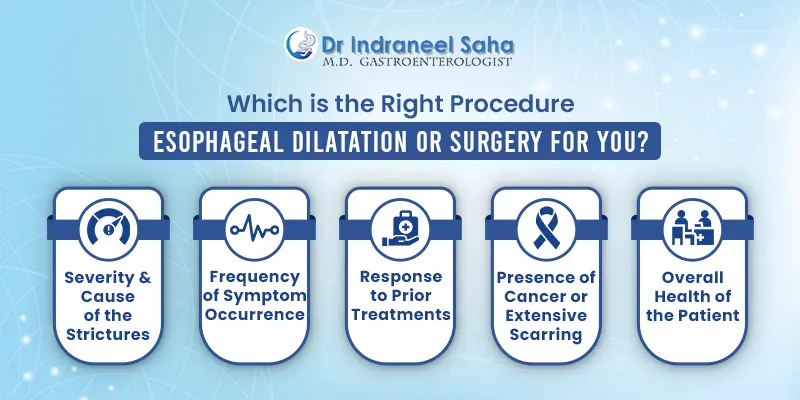
Which is the Right Procedure for You?
The decision to choose between esophagal dilatation and surgical intervention is only determined after consultation with a gastroenterologist like Dr. Indraneel Saha.
In the majority of patients, the choice of treatment actually depends on the following factors.
- Severity and Cause of the Strictures
- Frequency of Symptom Occurrence
- Response to Prior Treatments
- Presence of Cancer or Extensive Scarring
- Overall Health of the Patient.
For most individuals with benign strictures, Dr. Indraneel Saha suggests esophageal dilatation as the first line of treatment because of its safety, effectiveness, minimally invasive nature, and quick recovery.
Surgery is only recommended in rare cases where dilatation is not that effective or proves to be unsuccessful.
Conclusion
If you are suffering from difficulty in swallowing, make sure not to ignore the condition. It is always a better idea to go for an early consultation to prevent complications. Both esophageal dilatation and surgery are effective options.
However, the right approach is only determined by a thorough consultation with a gastroenterologist like Dr. Indraneel Saha, who will assess your treatment plan and prepare the right treatment plan to help you regain your normal swallowing without any challenges.