- 9th May, 2026
- Capsule Endoscopy
Future Of Capsule Endoscopy & Gastrointestinal Imaging
Capsule endoscopy has emerged as a revolutionary tool that has transformed the diagnosis of gastrointestinal conditions. You just have to swallow a tiny capsule that will travel through your digestive tract and capture high-definition images.
With rapid advancements in imaging and artificial intelligence, capsule endoscopy is expanding far beyond its current capabilities, promising a future where gastrointestinal imaging is faster, smarter and more patient-friendly.
Current Role Of Capsule Endoscopy
Since the introduction of capsule endoscopy in 2000, the procedure has gained popularity as an alternative to traditional endoscopy for diagnosing gastrointestinal diseases.
Traditional endocopy, while invaluable, comes with certain limitations, which are as follows:
- Discomfort: The procedure involves inserting a long, flexible tube through the mouth or rectum, which can cause bloating and abdominal discomfort in some patients. Hence, patients are sedated to reduce anxiety.
- Limited reach: Traditional endoscopy may not fully visualise areas of the small intestine, thereby leaving some diseases undetected.
- Recovery: If complications such as bleeding and perforation arise, the recovery time can be longer.
In contrast, capsule endoscopy offers a non-invasive, convenient alternative. The procedure involves swallowing a small, ingestible vitamin-sized capsule that is equipped with a miniature camera. The capsule transmits thousands of images as it passes naturally through the digestive tract.
This allows the doctors to identify unexplained diseases, including small bowel diseases, obscure gastrointestinal bleeding, Crohn’s disease, and early-stage tumours that conventional endoscopy may miss.
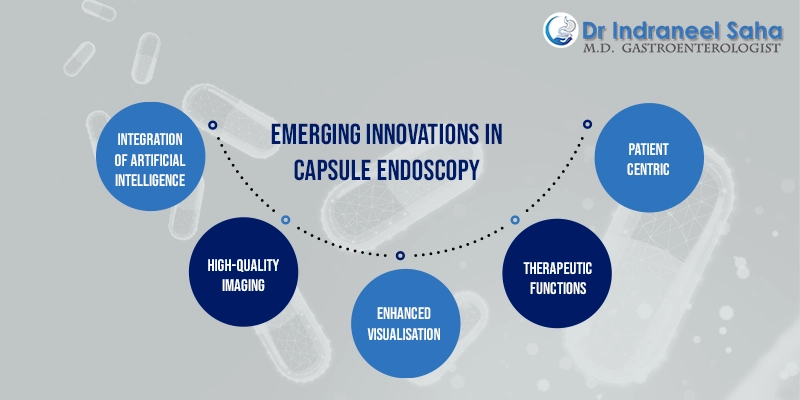
Emerging Innovations In Capsule Endoscopy
- Integration of artificial intelligence
AIs in capsule endoscopy are trained to automatically analyse the thousands of images to detect abnormalities like ulcers, bleeding and polyps in a few minutes. This improves accuracy, saves reading time spent on reviewing the footage, and ensures that subtle lesions are not overlooked.
- High-quality imaging
One of the defining features of capsule endoscopy is its ability to capture superior-quality and high-resolution images of the gastrointestinal tract, particularly the areas that are difficult to reach. Modern capsules are equipped with advanced miniaturised cameras that are capable of taking pictures to allow clinicians to examine the mucosal surface in unprecedented detail, helping the detection of subtle lesions, small polyps, and vascular abnormalities.
- Enhanced visualisation
Research suggests that future capsules are expected to combine multiple imaging technologies in a single device. Techniques like virtual chromoendoscopy, spectrum-aided visual enhancer, or fluorescence imaging could be incorporated. This will provide layered, high-resolution views of the gastrointestinal wall and vascular structures.
- Therapeutic functions
The role of capsule endoscopy is rapidly evolving beyond just imaging. New studies are exploring capsules that can deliver drugs, take tissue biopsies, and perform micro-surgeries. This could shift capsule endoscopy from a diagnostic to a fully therapeutic, non-invasive gastrointestinal tool.
- Patient-centric
Last but not least, advancements in capsule design will continue to prioritise patient comfort and accessibility. Modern capsule designs are already small, ingestible, and non-invasive; ongoing innovations are making them even smaller, lighter, and more efficient, with longer battery life to capture extended imaging of the gastrointestinal tract. These improvements mean that patients can undergo thorough evaluations without any discomfort.
Are There Any Challenges?
- Data overload: Each procedure takes thousands of images, requiring efficient AI analysis. If algorithms are not trained properly, there is a risk of false narratives.
- Cost: Capsule endoscopy can be a bit expensive compared to traditional endoscopes, which can limit its widespread adoption.
- Incomplete visualisation: The capsule moves quickly through the digestive tract, which means it may miss areas if transit is too fast or slow, which can result in blurry images.
Conclusion
As technology continues to develop, capsule endoscopy is going to become a comprehensive, minimally invasive solution for gastrointestinal healthcare.
If you need to undergo capsule endoscopy, get in touch with Dr. Indraneel Saha, a specialist in capsule endoscopy and other endoscopic procedures.