- 30th Jul, 2025
- Pancreas Doctor
Pancreatitis vs. Gallstones: How Diagnostic Methods Differ
Abdominal pain, nausea, vomitting and digestive discomfort are some of the common symptoms that are related to issues in the digestive tract. Among them, the two most prevalent conditions are gallstones and pancreatitis.
While these two are different conditions, but are present with many similarities, especially when it comes to their symptoms. This makes diagnosing the disorders quite challenging for the doctors. Hence, they employ distinct diagnostic techniques and medical evaluations to distinguish between them and ensure correct treatment for patients.
In this blog, we will discuss the diagnostic methods of both pancreatitis and gallstones and the importance of timely intervention.
What Is Pancreatitis?
Pancreatitis refers to inflammation of the pancreas, the gland located behind the stomach that produces digestive enzymes and insulin. It can either be temporary and occur suddenly (acute) or develop slowly over time, leading to a life-threatening situation (chronic).
Symptoms
Warning signs of pancreatitis depend on whether it is acute or chronic, stated a pancreas specialist doctor in Kolkata.
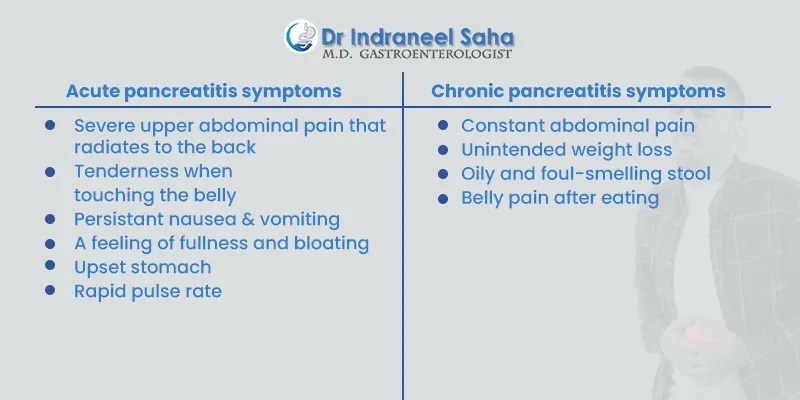
Acute Pancreatitis Symptoms
- Severe upper abdominal pain that radiates to the back
- Tenderness when touching the belly
- Persistant nausea and vomiting
- A feeling of fullness and bloating
- Upset stomach
- Rapid pulse rate
Chronic Pancreatitis Symptoms
- Constant abdominal pain
- Unintended weight loss
- Oily and foul-smelling stool
- Belly pain after eating
Diagnostic Methods For Pancreatitis
The diagnosis of pancreatitis begins with a complete medical history and thorough examination of the physical health.
A pancreas specialist doctor in Kolkata, like Dr. Indraneel Saha, also recommends blood tests that include the following:
- Complete blood count (CBC): It is done to check for the white blood count, which is usually elevated during inflammatory conditions like pancreatitis.
- Amylase and lipase: Higher levels of these digestive enzymes indicate inflammation and infection in the pancreas.
- Blood sugar: Abnormality in glucose signifies pancreatic dysfunction or complications.
- Triglyceride Levels: Triglyceride (TG) levels greater than 1000 mg/dl can mean the progression of acute pancreatitis.
Imaging tests also play an important role in confirming the presence of pancreatitis and ruling out other conditions.
- Ultrasound: It is done to look for gallstones, which trigger pancreatic attacks.
- Computerised tomography (CT) scan: A CT scan provides a detailed image of the pancreas, helping to identigy inflammation and fluid collections.
- Magnetic resonance imaging (MRI): It is a non-invasive way to view the pancreatic and bile ducts if any structural issues are suspected.
The following endoscopic procedure is also suggested.
- Endoscopic Retrograde Cholangiopancreatography: ERCP uses a flexible tube to detect issues in the pancreatic duct and to look at the drainage of the pancreas.
What Are Gallstones?
Gallstones are hardened deposits of bile in the gallbladder. They can range from the size of a grain of sand to a golf ball and are mainly caused due to excessive amounts of bilirubin and cholesterol. When these stones block the bile ducts, it leads to potential complications.
Symptoms
- Patients with gallstones usually experience the following signs:
- Intense and severe abdominal pain in the upper right or middle of the abdomen.
- Yellowing of the skin and eyes (Jaundice)
- Dark urine and pale stools
- Indigestion and bloating
- Digestive discomfort, like nausea and vomiting
Diagnostic Methods For Gallstones
Since the symptoms of gallstones are almost similar to pancreatitis, precise and advanced diagnostic tools are used to confirm their presence, stated a pancreas specialist doctor in Kolkata.
The diagnosis of gallbladder stones also involves a detailed discussion about the symptoms. The doctor also checks for tenderness in the belly and signs of inflammation.
Based on the outcomes, the following blood tests are recommended.
- White Blood Cell Count (WBC): An elevated count indicates an infection, which might be associated with gallstones or cholecystitis.
- Liver function test: It is done to assess the liver enzyme levels, which can increase due to gallstones or bile duct obstruction.
Similarly, to rule out other conditions, the following imaging techniques are used.
- Abdominal ultrasound: It is a non-invasive test to detect stones and inflammation in the gallbladder.
- Computerised tomography (CT) scan: It provides cross-sectional images of the gallbladder, which helps in detecting small stones and complications like perforation.
- Magnetic resonance imaging (MRI): When ultrasound fails to provide accurate results, MRI is done to detect stones in the bile ducts by giving high-resolution images.
- Hepatobiliary Iminodiacetic Acid(HIDA) Scan: It is a nuclear medicine imaging test to determine how well the gallbladder is functioning and whether the bile is flowing freely through the gallbladder and bile ducts.
Conclusion
Both pancreatitis and gallstones affect the abdomen and overlap with each other. Hence, doctors use different diagnostic procedures for evaluation. If you are experiencing digestive issues for a long time, reach out to a pancreas specialist doctor in kolkata for early detection. Timely intervention and treatment prevent serious health concerns.