- 28th Apr, 2026
- Capsule Endoscopy
Struggling With Unexplained GI Symptoms? Capsule Endoscopy Can Be the Answer
Digestive discomfort is something that most of us experience, like, for instance, bloating, nausea, occasional stomach cramps or mild acidity, especially after a heavy meal. In the majority of patients, these issues are quite normal and get resolved with over-the-counter medicines.
However, when these symptoms persist, worsen, or standard tests fail to provide answers, it becomes frustrating. Not only that, for many patients, not knowing the actual cause can really be worrying and indicate something is wrong with the GI tract.
However, the advancements in medical technology have given rise to capsule endoscopy, a modern minimally invasive diagnostic procedure that has revolutionised the way gastrointestinal disorders are treated.
The test allows doctors to explore the areas of the small intestine that are difficult to reach by standard procedures.
What Are Some Of The Unexplained Gi Symptoms?
Some GI symptoms are hard to detect because they overlap with signs related to other conditions. They are termed “unexplained” as they are present or recur without any identifiable cause, even after undergoing routine tests like blood tests, imaging tests and traditional endoscopy.
Let’s take a look at some of them for which gastroenterologists like Dr. Indraneel Saha recommend capsule endoscopy.
- Abdominal pain: The pain is recurrent and often mimics discomfort from gynaecologic, urinary, or musculoskeletal conditions. Patients often experience cramps, which can last for a few hours to even days.
- Bloating: This is another symptom that often challenges diagnosis. Patients may feel fullness, tightness, or visible swelling of the abdomen.
- Nausea and vomiting: Individuals also reported experiencing nausea, accompanied by episodes of vomiting. This makes eating really uncomfortable and interferes with digestion.
- Altered bowel movements: Chronic diarrhoea, constipation, or alternate patterns of bowel movements might also occur, thereby making abdominal discomfort even worse and uncomfortable.
- Reflux or heartburn: Persistent throwing up of the stomach’s acidic content along with chest discomfort or burning sensation. These symptoms signify other conditions related to cardiac disorders.
- Non-specific symptoms: This includes gas, belching, or intermittent abdominal discomfort that does not fit neatly into any specific diagnosis. These symptoms are often fluctuating and may be influenced by diet, stress, or functional gastrointestinal disorders.
Understanding Capsule Endoscopy
Capsule endoscopy is a new approach to diagnosing gastrointestinal disorders. It is a procedure that involves swallowing a pill-sized capsule that is equipped with a miniature camera, light source, battery, and transmitter.
As the capsule passes through the digestive tract, it captures thousands of high-resolution images that are transmitted to the recorder worn by the patient. Gastroenterologists like Dr. Indraneel Saha carefully review these images to detect the abnormalities.
As compared to conventional endoscopic methods, capsule endoscopy does not require sedation, invasive methods or hospital stays. It is completely painless, safe, and allows doctors to examine areas that are otherwise inaccessible.
The capsule is naturally excreted through the body in the stool, usually within 24 to 48 hours, without causing any discomfort.
How Does The Procedure Work?
Capsule endoscopy is a simple process, and here is how the procedure works.
- Preparation: Patients are generally advised by Dr. Indraneel Saha to fast for at least 8–12 hours before swallowing the capsule. Sometimes, a mild laxative or stool softener is prescribed, especially for patients with constipation, to ensure the small intestine is clear for capturing the images.
- Swallowing the capsule: The capsule is about the size of a large vitamin pill. Once swallowed, it begins its journey through the digestive system.
- Image capture: During the whole time, the capsule takes thousands of images of the intestinal walls. These pictures provide detailed insight into inflammation, bleeding, ulcers, polyps, or tumours.
- Data retrieval: After that, the images that are taken are transmitted wirelessly to a small recording device worn on the patient’s waist or shoulder. Once the capsule passes naturally through the digestive system, the recorded images are analysed by a specialist.
- Diagnosis and follow-up: Based on the pictures, the doctor can identify abnormalities, plan treatments, or recommend further interventions if necessary.
Conditions That Are Diagnosed With Capsule Endoscopy
Capsule endoscopy is really effective in diagnosing the following conditions.
- Obscure GI bleeding: The most common indication to undergo capsule endoscopy is to identify the source of bleeding in the small intestine, particularly when findings from upper endoscopy and colonoscopy are normal.
- Suspected Crohn’s disease: It results in inflammation of the digestive tract, causing severe abdominal pain, chronic diarrhoea, unexplained weight loss, fatigue, and fever. Capsule endoscopy can help visualise early inflammation, small ulcers, or mucosal changes in the small intestine.
- Inflammatory bowel disease: It refers to chronic inflammatory conditions in the gastrointestinal tract. When standard diagnostic measures remain conclusive, capsule endoscopy assesses the inflammation in parts of the small intestine that help in the detection of the disorders.
- Celiac disease: Here, the small intestinal wall gets damaged, triggered by gluten intake. It is an autoimmune condition that affects nutrient absorption and can lead to symptoms such as diarrhoea, weight loss, fatigue, and bloating. With the help of capsule endoscopy, doctors can help visualise characteristic changes in the small intestine.
- Small bowel tumours: They are relatively rare but can be serious, especially if not detected early. Capsule endoscopy enables detailed visualisation of the small intestine and can help identify abnormal growths, polyps, or masses that may not be visible through conventional imaging or endoscopy.
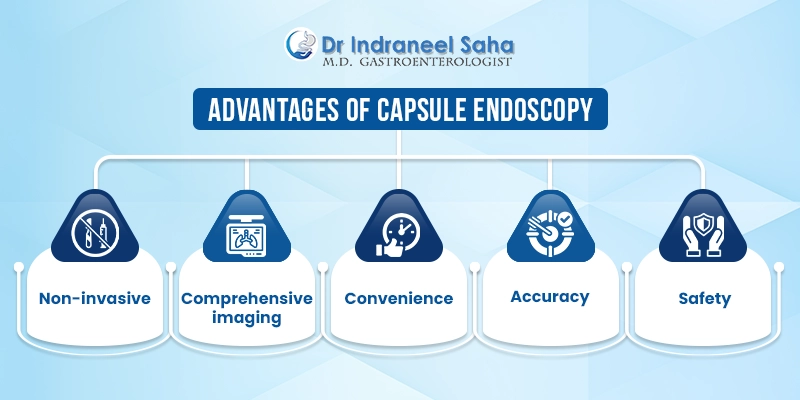
What Are The Advantages Of Capsule Endoscopy?
The procedure offers several distinct advantages, such as the following.
- Non-invasive: Patients do not require sedation or experience any kind of discomfort.
- Comprehensive imaging: The procedure is appreciated for its ability to reach areas of the small intestine that are unreachable by standard scopes.
- Convenience: Another major benefit is the convenience, which means patients can continue their activities during the test.
- Accuracy: The procedure captures high-resolution images for accurate diagnosis.
- Safety: Capsule endoscopy does not cause any risks both during and after the examination as compared to invasive procedures.
Conclusion
If you have been struggling with gastrointestinal symptoms for a long time and traditional tests have not provided any clarity, book an appointment with Dr. Indraneel Saha to discuss undergoing capsule endoscopy as the next step toward relief.