- 26th Apr, 2026
- Esophageal Dilatation
Who Needs Esophageal Dilatation?
You are having your meal, but suddenly feel like the food is stuck in your chest. For many individuals, swallowing difficulty is not an occasional discomfort but a reality that they struggle with every day.
Persistent difficulty in swallowing primarily occurs due to the narrowing of the esophagus and the most effective treatment approach is esophageal dilatation.
It is often performed as an outpatient procedure by a trained gastroenterologist like Dr. Indraneel Saha to provide relief from the narrowing of the strictures.
But the thing is that not all patients with constricted esophagus require this procedure. Deciding who truly benefits from the procedure depends upon the severity, cause and the frequency of symptoms.
What Is Esophageal Dilatation?
Esophageal dilatation is a medical procedure that is recommended by a gastroenterologist to widen a narrowed section of the esophagus (the tube that carries food from the mouth to the stomach).
Narrowing of the esophagus is caused by various reasons, and when it becomes chronic, it starts to interfere with daily living. In the medical context, the condition is known as dysphagia.
The procedure involves gently improving swallowing difficulties by gently stretching using specialised instruments such as balloons or dilators.
How Does The Procedure Work?
Here is the step-by-step guide on how esophageal dilatation works.
- Preparation
Patients are asked to avoid eating or drinking for at least a few hours before the procedure to make sure that the esophagus is clear.
- Sedation
Dr. Indraneel Saha also uses a mild sedative to help patients relax and stay comfortable throughout the procedure. It reduces anxiety, discomfort and makes you feel at ease throughout the procedure.
- Endoscope insertion
After that, a thin, flexible tube called an endoscope is gently passed through the mouth into the esophagus which allows the doctor to clearly view the narrowed area.
- Dilatation
The doctor then uses specialised instruments, such as balloons or dilators, to carefully stretch the narrowed section to the desired size to restore the normal passage for food.
- Completion and recovery
The whole procedure typically takes about 15–30 minutes to complete. In most cases, patients are able to go home on the same day.
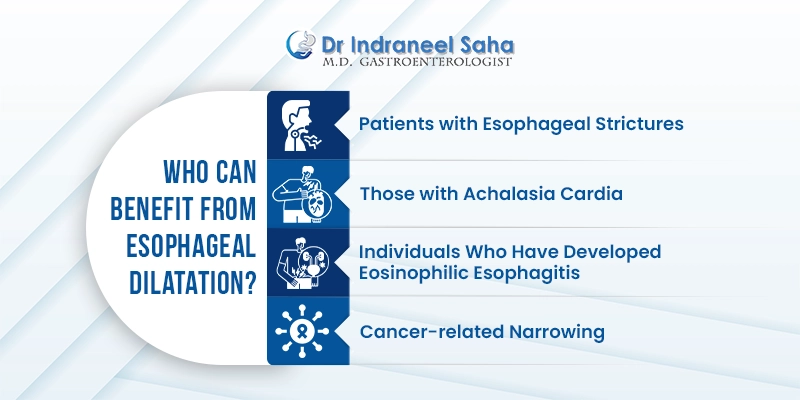
Who Can Benefit From Esophageal Dilatation?
Not everyone with swallowing difficulties requires esophagal dilatation. However, it is mainly suggested for individuals whose symptoms are caused by structural narrowing or obstruction of the esophagus.
Let’s take a look at the most common groups of people who will benefit from the procedure.
- Patients with Esophageal Strictures
The first reason for esophageal dilatation is narrowing of the esophagus, or better known as esophageal strictures, which is mainly caused by irritation or inflammation of the esophagus. People with gastroesophageal reflux disease (GERD) are particularly at risk. When left untreated, the stomach acid damages the esophageal lining, leading to scar tissue formation and narrowing.
- Those with Achalasia Cardia
It is a rare disorder of the esophagus where the lower esophageal sphincter fails to relax properly, resulting in a functional obstruction in swallowing both solids and liquids. For such patients, a special type of esophageal dilatation known as pneumatic balloon dilatation is a primary non-surgical treatment to relax the LES and improve swallowing.
- Individuals Who Have Developed Eosinophilic Esophagitis
Eosinophilic esophagitis is a chronic and allergic disease where white blood cells (eosinophils) accumulate in the esophagus, causing inflammation and damage. Patients with the condition experience chest discomfort and chronic swallowing difficulty. While medications and dietary changes might work, esophageal dilatation becomes necessary in severe cases.
- Cancer-related Narrowing
In some patients, the esophagus gets narrowed due to the presence of a tumour known as esophageal cancer. While dilatation does not treat the disorder, it offers palliative relief by reducing discomfort and improving swallowing.
Conclusion
If swallowing is becoming a challenge, it’s time to seek immediate medical advice from Dr. Indraneel Saha. Esophageal dilatation is not just a procedure; it is a safe and effective solution to restore normal eating and lead a comfortable life.