- 5th Jun, 2026
- Capsule Endoscopy
Capsule Endoscopy vs. Conventional Endoscopy: What’s the Difference?
What if your digestive tract could be diagnosed with simply swallowing a capsule? No tubes, no sedation, and no hospital stay. Advancements in medical technology have made it possible through capsule endoscopy.
It is a revolutionary, minimally invasive diagnostic procedure that is a better alternative to conventional endoscopy. Though both techniques provide a clear view of the gastrointestinal tract, when it comes to detecting unexplained abdominal pain, bleeding, and chronic diarrhoea, gastroenterologists suggest capsule endoscopy.
So, what’s the reason behind it?
Let’s understand the key differences between capsule and conventional endoscopy and why the first one is a better option.
Understanding Capsule Endoscopy
Capsule endoscopy is a minimally invasive procedure that involves swallowing a tiny camera enclosed in a capsule, which is similar in size to the size of a vitamin pill.
The capsule passes through the digestive tract, taking thousands of pictures along the way as it travels. These images are then transmitted to the recording device worn by the patient, which is then reviewed by a gastroenterologist to find out the abnormality.
Dr. Indraneel Saha, a leading gastroenterologist in Kolkata, usually recommends capsule endoscopy for small intestine evaluations to identify conditions such as Crohn’s disease, small bowel tumours, celiac disease, and sources of unexplained gastrointestinal bleeding.
What is Conventional Endoscopy?
Conventional endoscopy, on the other hand, involves insertion of a flexible tube equipped with a camera and light source into the digestive tract. The procedure is performed either through the mouth or the rectum.
The method allows the gastroenterologist to view the digestive tract in real time. In addition to diagnosis, conventional endoscopy also enables doctors to perform therapeutic procedures such as taking tissue biopsies, removing polyps, or treating certain abnormalities during the same session.
Traditional endoscopic procedures, though highly effective, require preparation, possible sedation, and a recovery period.
Differences Between Capsule Endoscopy and Conventional Endoscopy
- Level of Invasiveness
One of the noticeable differences between the two is patient experience. With capsule endoscopy, individuals are required to swallow the capsule and continue their daily activities while the camera captures the images. The procedure is completely painless and does not require any sedation.
However, as mentioned, conventional endoscopic techniques involve inserting a tube into the digestive tract. Though the procedure is performed under sedation, patients still feel anxious after the examination. Moreover, patients are also required to take some time due to the effects of sedation.
- Visualisation
The main advantage of capsule endoscopy is that the procedure can visualise areas of the small intestine that are difficult to access by traditional endoscopic procedures. For conditions related to the small intestine, capsule endoscopy is the preferred option.
Conventional endoscopy is also useful for examining the stomach, duodenum, colon, and rectum. However, it may not provide a complete view of the entire small bowel.
- Diagnostic Capabilities
Both procedures are beneficial, but their capabilities differ. Capsule endoscopy provides detailed images of the gastrointestinal tract to identify inflammation, bleeding, and tumours. But it cannot perform additional procedures.
Conventional endoscopy also provides images and even allows doctors to take out tissues for biopsies, stop bleeding, remove growths, or widen narrowed passages.
- Safety
Capsule and conventional endoscopy are safe, especially when performed by experienced gastroenterologists. The major drawback of capsule endoscopy is that it carries the risk of capsule retention, particularly in patients with bowel strictures or obstructions.
The potential complications of traditional endoscopic techniques include bleeding, infection, or perforation, though risks are very rare.
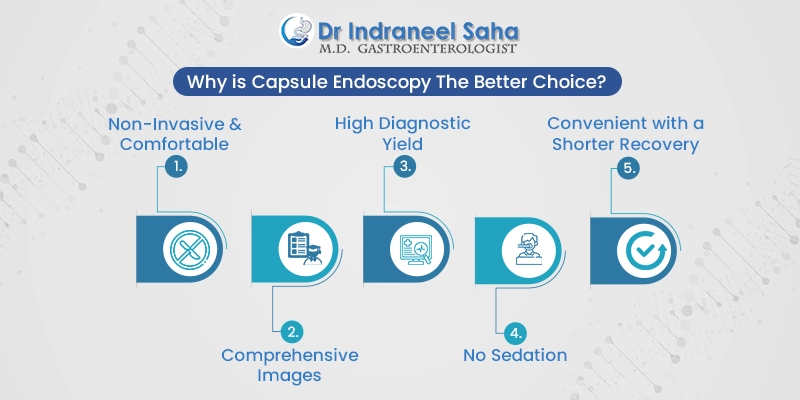
Why is Capsule Endoscopy the Better Choice?
Capsule endoscopy comes with several advantages, such as the following.
- Non-invasive and comfortable
- Comprehensive images
- High diagnostic yield
- No sedation
- Convenient with a shorter recovery time
Conclusion
Capsule endoscopy has emerged as a popular diagnostic tool for gastrointestinal care. However, it is advisable to get in touch with an expert gastroenterologist like Dr. Indraneel Saha, who will evaluate your symptoms and recommend the most appropriate approach for your specific needs.