- 18th Sep, 2026
- Pancreas Doctor
Pancreatic Cysts: Are They Always a Cause for Concern?
A pancreatic cyst may sound alarming, especially when it is discovered unexpectedly during an ultrasound, CT scan or MRI.
You went to get yourself checked, but the report mentions that you have pancreatic cysts.
Getting diagnosed with pancreatic cysts brings up different questions, which are valid. One might think, Is this cancer? Did I do something to cause it? Do I need surgery right away?
Pancreatic cysts are quite common, and their prevalence is mostly detected during imaging studies. In the vast majority of patients, they are benign and might not cause any symptoms at all.
But this is not necessarily the case with every cyst on the pancreas. Some types can carry a risk of becoming cancerous and therefore need careful evaluation and regular monitoring.
This is why exactly why delaying treatment is not always the right approach, and why understanding what type of cyst you have matters so much.
In this write-up, you will get to know what pancreatic cysts actually are, why they occur, the warning signs to consult a pancreas specialist doctor in Kolkata, and the types that deserve watching closely.
What Are Pancreatic Cysts?
The pancreas is an organ located behind the stomach. The organ plays a role in digestion by producing digestive enzymes and also helps regulate blood sugar by producing hormones such as insulin.
They are fluid-filled sac pockets that form within or on the surface of the pancreas. All pancreatic cysts are not the same; they vary in size, appearance and behaviour. Most of the time, they are detected, especially when imaging examinations are performed for any other health issues. But in some individuals, they are diagnosed when a person experiences abdominal discomfort or symptoms associated with pancreatitis.
What Are the Types of Pancreatic Cysts?
A pancreas specialist doctor usually broadly divides the cysts into primary categories.
- Non-Neoplastic
They are commonly referred to as the “pseudocysts”. This is because they are not cancerous tumours at all. They mainly develop after an episode of pancreatitis (inflammation of the pancreas) or an injury, when fluid and enzymes leak out and get walled off by surrounding tissue. They contain blood, diet and debris and usually do not have the risk of turning cancerous. They are generally small, grow very slowly, and heal on their own, particularly when the underlying inflammation resolves. However, the ones causing troublesome symptoms require drainage or other treatment.
- Neoplastic
They are abnormal tumour cells that either form within the tissue or ducts of the pancreas. Though they are benign, some have the potential to turn malignant over months or years. They are classified as follows.
- Serous Cystadenomas – Usually benign tumours often filled with tiny water-like cysts. They rarely turn cancerous but need periodic monitoring.
- Intraductal Papillary Mucinous Neoplasms (IPMNs) – They grow inside the main or branch pancreatic ducts, sometimes causing the duct to widen. They carry thick mucus and have a high chance of becoming cancerous.
- Mucinous Cystic Neoplasms (MCNs) – They are thick-walled and mucin-producing cysts that occur at the body or tail of the pancreas, mostly in women. They can become cancerous if not treated and are therefore recommended for surgical removal once diagnosed.
Are There Any Symptoms of Pancreatic Cysts?
The majority of pancreatic cysts are present with no symptoms. They are completely silent, with no abdominal pain or digestive discomfort at all. This is the main reason why they are discovered by accident, because patients remain unaware that they have pancreatic cysts.
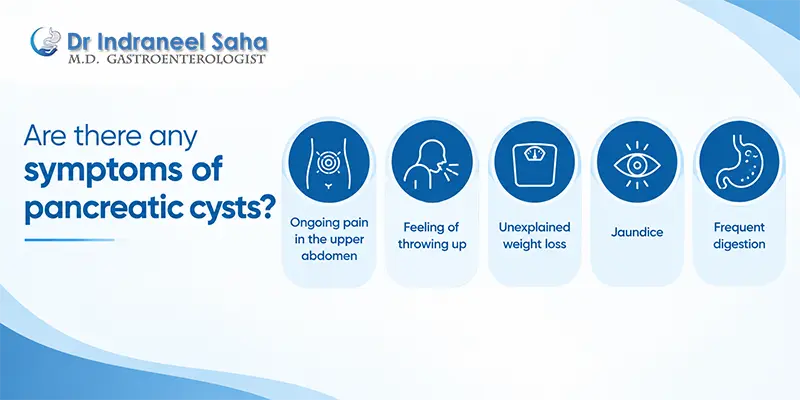
However, when the cysts grow in size and press against the organ, they give rise to symptoms. Dr. Indraneel Saha, a pancreas specialist doctor in Kolkata, lists the following signs that he has encountered in patients.
- Ongoing pain in the upper abdomen that radiates to the back.
- Fullness or a feeling of throwing up even after a small amount of food.
- Unexplained weight loss without even trying.
- Jaundice (yellowing of the skin or eyes), if the cyst blocks the bile duct
- A mass or swelling in the upper belly
- Light-coloured or greasy stools.
- Frequent digestion
- Recurrent pancreatitis
It might happen that a pancreatic cyst can rupture when left unaddressed. It is a medical emergency and requires immediate treatment.
When Do You Need to Worry About Pancreatic Cysts?
- It continues to grow over time.
- When they become relatively large
- A nodule or solid area within the cyst
- The cyst leads to the widening of the pancreatic duct.
- The individual starts experiencing ongoing symptoms such as jaundice or persistent abdominal pain.
- The cyst shows concerning features on CT or MRI.
- The report shows other findings that suggest malignant transformation
In simpler terms, the presence of a pancreatic cyst does not determine the severity of the condition. It is determined by its shape, size, growth pattern and associated symptoms.
What Are the Treatment Options?
Treatment is not the same for all pancreatic cysts. A pancreas specialist doctor in Kolkata decides the approach based on the cyst’s risk.
- Surgery: It is performed if the cyst has a high chance of becoming cancerous or causes complications that can’t be managed otherwise. It might involve part of the pancreas rather than the whole organ itself.
- Drainage: They are suggested for pseudocysts, particularly those which are large, causing pain or blocking digestion, often performed endoscopically rather than through open surgery.
- Monitoring: The small, symptomatic and low-risk cyst to catch early signs of complications.
- Treatment of the Underlying Cause: If the cyst develops due to recurring pancreatitis, treating the inflammation is important.
Conclusion
A pancreatic cyst is not always a cause for panic, but it shouldn’t be ignored for long. If a diagnostic procedure has flagged a pancreatic cyst, or you have been dealing with constant abdominal issues, get yourself checked by a pancreas specialist doctor in Kolkata to understand which category of cyst and whether any further monitoring is needed.